Sunday, October 18, 2009

The Real Asia: Ho Chi Minh City

You don't have to travel very far from its airport to reach the thick of Ho Chi Minh City. The city announces itself with irritating hums and honks from swaths of mopeds clogging its arteries. Somehow traffic flows, but I saw at least three collisions between bikers during my 20 minute drive from the terminal to my hotel. One was at slower speed, and it was humorous watching the two men stand up, brush themselves off, nod in mutual apology and drive off as if it were part of some expected ritual.

Formerly known as Saigon before the North Vietnamese defeated their capitalist brothers to the south, HCMC is still the hub for innovation in the country, and it - not Hanoi - is the steward of the recent free-market resurgence in the country. Make no mistake, it is still a socialist republic with a single, heavy handed ruling party. But unlike its much bigger communist neighbor, China, only 2.3% of Vietnamese citizens are actually card-carrying members of their nation's communist party.

Nevertheless, communism and its history in and influence on the country is difficult to miss - most notably at the War Remnants Museum. Situated smack dab in the middle of the city, this quirky homage to the Vietnam war displays abandon tanks and other contra either left by the U.S. and French or brought into the city by the Viet Cong when it took the city in 1975. The placards under the specimens cater shamelessly to the party's take on the times: "This M24 tank was commandeered by the liberating forces...," a subtle snub at the museum's 95% U.S. patronage. The museum houses other, darker exhibits as well.
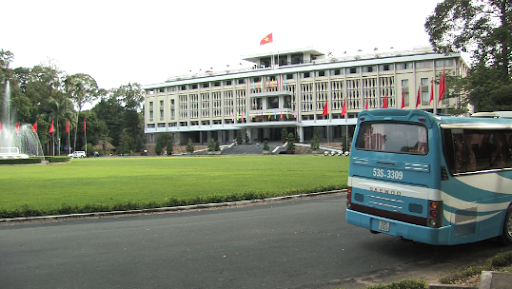


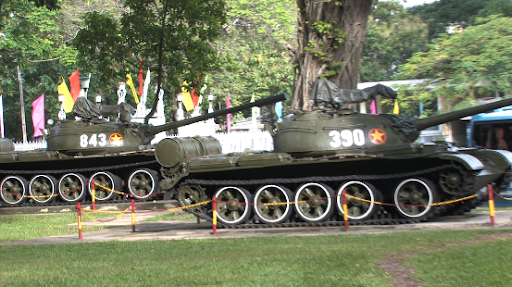
At the Reunification Palace, two Russian-built tanks - of the same model that broke down the building's gates to secure the Norh's victory - stand proudly in the courtyard with a fresh coat of army green. The palace was built in 1966 for South Vietnam's president. It has been left as it was taken in 1975 and opened up as a museum. Historical significance is the only thing making this structure worth visiting, and perhaps the shell of an F4 Phantom in the back lawn.


An odd thing about HCMC is that everyone wants to take you for a ride - literally. Walking for several hours through the city, I was courted continually by moped drivers offering to show me around the entire city for 30,000 dong. I had to laugh at the image of myself, 6' 4" clinging to a 5' 2" Vietnamese man on the back of a rickety Vespe. I politely declined each offer.

Really, the best way to get around HCMC is by foot. You would miss too much with motorized transportation. And the thrill of crossing a HCMC street, dodging cars, busses, and bikes alike, doubles as an extreme sport (Maintaining eye contact with the person's bike you are going to step in front of is key).


The only issue with walking is dealing with the street hawkers. For example, a young girl approached me as I was sitting at a corner, getting off my feet and admiring the Notre Dame cathedral. She was hellbent on selling me flowers, employing the rule of the five whys to counter my refusal. "You want to buy a flower," she said in perfect English. "No thank you," I said. "Why?" she replied. "Because I don't have any money," I lied. "Why?" "Because I don't have a job." Why? "Because I'm not so bright," "Why?" I gave in: "How much?" I paid 5000 dong for a wilted carnation (which she probably picked from a nearby park). I realized my mistake when several more children emerged from their hiding places to sell me postcards, kleenexes, coconuts, Vietnamese flags, and other trinkets and mementos. The savvy flower salesgirl strode away grinning.

Saturday, August 22, 2009

Masters of buoyancy

It's the ball to the boot of peninsular Malaysia - the country's Sicily if you will. The island of Tioman is a 90-minute ferry ride from the costal town of Mersing. Kate and I packed our courage to brave the deep and investigate the wrecks and wildlife of the island's extensive coral mantel.


With an longstanding fear of having her head underwater, Kate was a champ. After mastering equalization problems in her ears (known as a "squeeze", she descended swimmingly to 30 meters (100 feet). There we were greeted by sunken fishing vessels, rays, sea slugs, hawksbill turtles, brain coral, and fishes of overwhelming variety.

But it was not all underwater sightseeing. We were there on a mission to secure our advanced diver certification. And that is what we did. Two days of theory and three days of dive after dive, we made it - thanks to a great guide and a little Actifed.

Here are a few shots of the course, the tribulations, and the rewards:

Saturday, August 01, 2009

Having fun with Shibuya square (渋谷区)

Not much of a post. Just having some fun. This is Shibuya square, shot from the upper-level of a Starbucks in Tokyo. The rain was coming down, and it was fun to catch the commuters with their umbrellas popped and scrambling to their offices.

The real Asia: Tsukiji central fish market (築地市場)

Japan's stoic fishermen trade billions worth of fish a year at the Tsukiji central fish market. This covered labyrinth boasts tuna, octopus, salmon, sea urchin, crab, prawn, oyster, abalone, flounder, sea bass, and any other fruit of the sea imaginable (and many that are not). Styrofoam cases filled with fish and ice line the corridors, chilling the lanes through which traders lug their laden barrows and recklessly steer their gas-powered carts.

The smell is conspicuously un-fishy. It is all fresh, brought on shore no more than an hour ago. It is 5:00 a.m., and we hitch a ride on a barrel-engine go-cart, holding on tightly as the driver swerves between piles of the day's catch. Our destination is the main attraction: the wholesale tuna trade.

The viewing section in the hall is packed with tourists, some of whom are making their last stop of a long, no-doubt alcohol-charged night. A uniformed man frantically pleas with the masses to shut off their flashes, lest the bidders' view of rows of tuna be hampered during the intense auctioning. The bells sound, and the bidders' shouts echo through the frosty arena and the flashes intensify.

We squeeze out of the crowd and into a slight drizzle. We seek shelter for our cameras among the fishy catacombs, where traders are already processing their purchase. A stout man in a T-shirt and hachimaki smokes a cigarette with the corner of his mouth while his hands are busy pushing a tuna torso through a band saw. Another trader performs surgery on a smaller specimen, removing fin and bone, while a woman, presumably his wife, counts yen bills in a small wooden booth next to him.

Strangely, the maze leads us seemingly intentionally to an aisle full of sushi shops. We sit down to a cup of tea and delve into a bowl of miso soup and several slivers of sashimi on sesame rice. It is 7:30 a.m.

Saturday, July 18, 2009

Launchn' at Clarke Quay
Along the Singapore river at Clarke Quay you will find an amusement park niche, a small plot of land with two rides. The first one is an upside-down bungee, which Kate and I braved during her folks' visit. The second one is a subject of another story.

Saturday, July 11, 2009

The real Asia: Noida, India

Those who have travelled to its neighbors often mock Singapore with the name "Asia Light." Having recently traveled to Delhi, Beijing, and Shanghai - within a week's time - I now understand why. And I now often scratch my head at those backpackers you sometimes see here, as if they were roughing it. There is no "roughing it" in Singapore.

To be fair, Singapore should pride itself on its efficiency and cleanliness - it often makes Germany feel like a Haitian squatter colony - but it is this immaculateness that makes the city so "un-Asian." As I am slowly learning, there is a real Asia still to be discovered. My first true encounter with Asia was Delhi.

India's capital

While peering out the window before landing in Delhi, I saw an expanse of varying shades of brown, a vision of what the dust bowl must have been decades ago in America's breadbasket. I stepped out of the cool Air India Boeing and into to a kiln. At this time of year, temperatures in Delhi range between the searing 44°C (111°F) in the day and a "balmy" 38°C (100°F) in the evening. Passengers then squeezed into a bus that took us to immigration. Because hygiene didn't seem to be a high priority among the guests, I'll just say that the short ride was an olfactory adventure.

Greeting us at the gate stood brown men in brown uniforms, brown berets, surgical masks, and with AK-47s. The Indian government wasn't messing around when it came to swine flu. As I stepped off, hoping for a bit of relief, they herded us into a group more cramped than on the bus. They examined us from a short but safe distance, looking out for any telltale sniffles and coughs, hoping to weed out those who had not come forward to the appeals the stewardesses had made in flight: "If you are not feeling well, or have flu like symptoms, please notify one of our cabin crew immediately."

Cleared of any illness, the travelers were allowed to pass and exploded into a an arena of health-check stations. Once cleared there, it was on to immigration, where disgruntled bureaucrats stamped visas without acknowledging the humans to whom they belonged. Passport marked, baggage collected (under suspicious looks from the security guard), I walked briskly past customs and into the chaos that is Indira Gandhi airport.

Saving me from the torrents of saris and kurtas was a small man, named Dabby, I think. Dabby wore the whitest suite I had ever seen. He donned newly bleached trousers, shirt, jacket, gloves, socks, and even white shoes. Looking excitedly into the eyes of each white person who approached (and saddened as they walked past), he held a printed sign with the text "MR. PERRY." "Close enough," I thought, and introduced myself. His perfectly white attire did not flatter his smile, which he cut upon shaking my hand.

Dabby drove me 30 minutes to a Radisson in the Delhi suburb of Noida. A Chinese manager met me at the doorway and took me up to my room, insisting that I leave my baggage below. With my MacBook and XH-A1 in the bags, that made me a little nervous. But no sooner had I entered the room, a bellhop slipped each bag through the door. I threw open the heavy curtains to see a group of youngsters in an intense game of cricket, as the sun set into the smoggy, dusty horizon.


On business

The whole purpose of this visit was to meet with one of our customers, a particularly special one. Unfortunately, I am not allowed to go into detail just yet, but an article on their business will be published soon. If you end up reading the piece, you'll see that the route from the hotel to the customer was nearly as interesting as the discussion with the CEO.

For the whole day, I had a very gracious colleague (see below) looking out for me, showing me the good Indian cuisine, driving me to the customer, giving me a tour of the office, and bringing me back to the hotel. He had more important work to do, I am sure, as he is responsible for several accounts in the area. Yet he treated me as if I were a customer. I was impressed not only with his hospitality, but also with his ability to dodge stray cattle on the highway and outmaneuver traffic cops attempting to pull him over for talking on his blackberry while driving. Thanks for the experience, Tarun!


Because this journey was for work, I had limited time to see anything beyond the route airport-hotel-customer. No Red Fort, no Jama Masjid, no trinket shopping. But after a short walk through the draught stricken suburb of Noida, chatting with security guards, watching another pick-up cricket match, fending off a small beggar child who clung to my leg until I coughed up 10 rupees, I did feel like I had properly been to India. Albeit not long enough.

Monday, May 25, 2009

The race to Lamanai

The New River is a twisty, meandering tributary that cuts through much of Belize. Along its shores nest hundreds of species of birds and an odd croc (yes, croc, not gator). The New is also the most direct route to one of Belize's most renowned historical sites: Lamanai.

Lamanai was established around 300 B.C. and was occupied all the way up to the 17th century by Mayan peoples. Lamanai itself means "submerged crocodile," which seemed logical, as the ruined state gives it a much lower profile than it must have had in past centuries.

I've slapped a few clips together from our excursion. If you look closely, you may see the group of Mennonites on tour.

Sunday, May 24, 2009

The crossing

Twenty or so miles north of Orange Walk lie the ruins of Cerros, an ancient Mayan outpost overlooking the natural harbor near modern-day Corozal, Belize. The only way to get there is with a 4x4 with plenty of ground clearance. As soon as you get off the beaten bath, you get on the battered path, resembling Verdun at around 1917. It's slow going unless you want to blow a tire, and that would be quite a pickle given the seclusion.

About three miles in (that's about twenty minutes), we came to what looked like an insurmountable barrier: the New River. All we could see on the other side was an illegible sign and what looked like a wrecked barge.

While contemplating whether to turn and head back, we noticed the barge getting ever so slowly closer. Faint cheesy melodies from a low-amp boom box betrayed the presence of a crew.

It was a makeshift ferry, cranked back and forth across the river by two diligent locals. You pay a small fee for passage, and they'll get you across. But one of the gents had no qualms about handing over the cranking duty to an overly ambitious gringo.

After disembarking, we headed on toward Cerros...strangely, the ferry was the highlight of the trip. A week later we learned that only a few days after our crossing a couple had forgotten to put on their parking break while on the same ferry. Let's hope their insurance covered that mishap.

Saturday, May 23, 2009

Tris learns to fish

Kate's brother in Belize, Tris, learned to fish on an outing with his grandfather. We sat back and enjoyed the lesson. Although you don't see the action so much here, Tris ended up catching more than anyone on the boat. The catch got cooked up a few days later back at an Orange Walk BBQ - Marie Sharp was again a most welcome guest.

Tris's grandfather is a versed outdoorsman. He's less the trapper-woodsman and more the jungle trekker, who decades ago led hunts through the rain forests of Central America. He had some valuable fishing tips to impart his grandson.

Wednesday, April 22, 2009

Kate launches "Flog"


Food of all kinds is everywhere in this country. Singapore's culinary artifacts are many and manifold, thanks to the four cultures that have meshed here over the last few hundred years.

In her food blog (or "Flog"), Kate is documenting her dining experiences like a true mushroom taster: there are many young adventurous ones, and many old cautious ones - but hardly any old adventurous ones. Let's see how long she lasts before we have to rush her to the ER.

Saturday, April 18, 2009

In suspense

This is the cool thing about high-rises in Singapore: window cleaners. They provide welcome distraction at work....Malaysian migrants polishing up the glass and giving you a sideways stare. I put this one on the spot.


Monday, April 13, 2009

A bit of photography

Kate has posted some of her albums on "A bit of everything." A good range of people, places, and things. She'll be keeping this updated regularly, with lots of stills from Southeast Asia. Looks like Malaysia will be next.

Sunday, April 12, 2009

The art of piñata...smashing

Pupils at an elementary school in Orange Walk demo their piñata-bludgeoning skills just before Christmas break. Belizeans have their own art to the tradition. Here a run-down of the techniques.

Saturday, April 11, 2009

Oh, what you can get in a can

These were all firsts for me: Green tea in a can, a barley drink in a "can," and...


...Colt 45 in a can. Had to travel half the globe to find that one. I'm not sure which is worse, that they actually offer it, or that it costs 2.50 a can.

Friday, April 10, 2009

Betty: the second coming

Not two months ago did I drop my faithful Betty off to the caprices of her next owner. It is therefore with solemn anticipation that I look to her successor...who officially arrived on the market this week. Sorry Betty I, for my fickle loyalty. Betty II, see you in a year or so, I hope.


Sunday, April 05, 2009

If this doesn't make you want to enroll your kids in Chinese classes...

...I'm not sure what will. This is a campaign that has been launched by the Promote Mandarin Council. Those who value linguistic diversity may not agree with the goal of the campaign; those who enjoy cute commercials won't care. These kids are impressive, and make me wish my brain cells hadn't hardened around red-neck English and a bit of High German.

Saturday, April 04, 2009

Everybody loves teacher Badhra

Badhra, Kate's good friend and one-time host mother from Belize, is a popular teacher - even when she isn't teaching. Kate and I got to experience the admiration her former students still have for her. Pretty amazing, really - at least I don't remember wanting to hug my second or third-grade teacher so much.

Sunday, March 22, 2009

The things you learn

You can learn a lot through a walk in Chinatown: which camera stores NOT to buy at, that a small bakery in the neighborhood called "Backstube" is quite popular among the locals, and how to prepare eel for dinner. That last one was particularly inspiring. Not for the squeamish.

Monday, March 16, 2009

Photo essay to bridge the gap

Some camera work during our exploration. The captions tell the story (be sure to click on the cartoon dialog box in the lower left corner).


Sunday, March 15, 2009

A bit of everything...as you haven't seen much of anything here


OK, Tramps Abroad is still on - but I doubt the frequency of the posts will keep up with what is going on over here (heck, I'm still working on posts from Belize). Therefore, Kate has seceded - to set up her own photo-blog on Singapore, and she is much more loyal than I to her readers. She already has several posts from our excursions and mishaps. 

Here it is: a bit of everything

Kate's photo-blog is much cooler, obviously, because she uses Mac software and photos she takes. I will still be here though, wallowing in my Web-app inferiority.